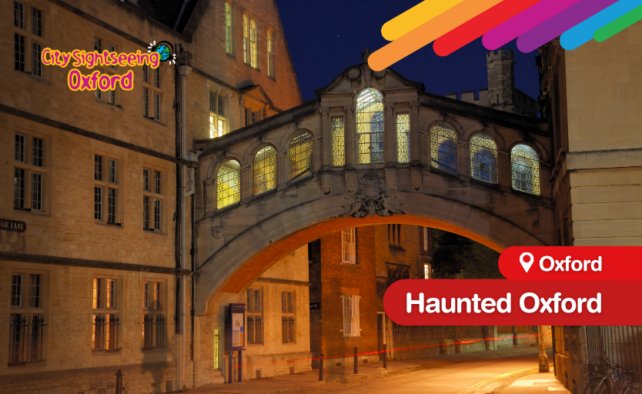

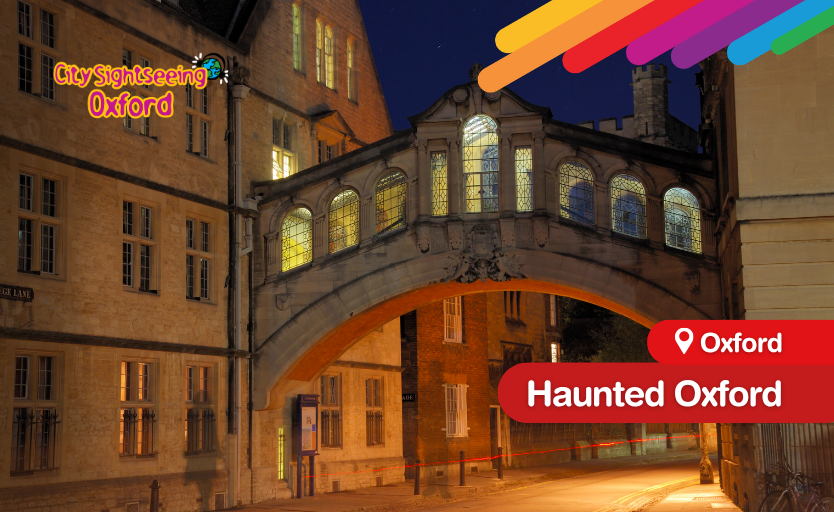
With a long and storied history, Oxfordshire is well known for having its fair share of ghosts, ghouls and legends that call the county home.
It was in Oxford that the twilight of the English Civil War came to a head, with King Charles I’s parliament moving here. It is also said that limestone holds ghostly energy, and Oxford is built largely from the very stone said to retain it.
Whatever the reason for the eerie residents of Oxford, there are plenty of them, and as All Hallows’ Eve approaches and the veil grows thinner, we’ve put together some of the spookiest stories and hauntings from around the city and beyond. After reading this blog, why not go and explore them for yourself? If you dare…
Ghosts and ghouls
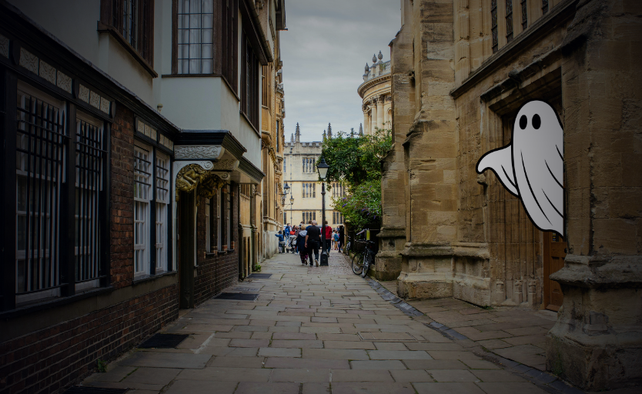
A ghost, it is said, is a spirit that remains in this world after death. Rather than moving on, it roams a place that was significant in their life, searching for a peace that is unknown to the living. Some ghosts, people believe, are simply recordings of past events, etched in stone and destined to play again and again. Other people reckon that ghostly illusions are the result of natural hallucinations or hazards and toxic substances that were used to build old, allegedly haunted buildings. Others take a more cautious view.
Whatever you believe, if you believe at all, these spectres are said to inhabit every corner of Oxfordshire, from pubs to colleges. Whether you’re an avid ghostbuster or a total non-believer, read on to find out more about the history and legend of some of Oxford’s phantom residents.

With a name like Dead Man’s Walk, this quiet footpath at the edge of Merton College is almost obliged to have a ghost story or two. In truth, the name comes from the days of Oxford’s medieval Jewish Quarter. During funeral processions, mourners would walk from the synagogue, where Tom Tower now stands, to their burial ground, now the site of the Oxford Botanic Garden. The ancient footpath they walked became known as Dead Man’s Walk and has gone by the name for over 800 years.
When the English Civil War broke out in 1642, Francis Windebank of Bletchingdon Park was quickly joined the Royalist cause in support of King Charles I. A colonel, Francis was newly married when Parliamentary forces attacked Bletchingdon during the Siege of Oxford in 1645. In a bid to save his wife and young daughter, Francis surrendered, handing his home over to Cromwell’s forces. Returning to Oxford, he was court-martialled by Prince Rupert, the King’s nephew and most celebrated General.
The morning of May 3rd, 1645, was cold. Dew drops settled on the grass of Merton Field, lined to the north by the Dead Man’s Walk and the ancient city wall. It was quiet; the fighting and gunfire coming to a halt as the sun rose to the east. Along the dirt path, Colonel Francis Windebank was marched by a group of soldiers, boots crunching on the frost-hardened ground. Standing against the wall that was once built to defend the city, he faced his executioners head-on. Baring his chest to the muskets, Francis cried at the top of his lungs, “God Save the King!” He was 31 when he died.
Today, on a cold, quiet morning, students and dog walkers taking the path along Merton College have often reported seeing a man walking back and forth. In full Royalist regalia, he patrols the wall on the lookout for Cromwell’s troops, loyal to his king even 400 years later. Those who claim to have seen this unearthly soldier have not been acknowledged by him. Instead, he simply marches back and forth.
Plan your journey to march with Francis Windebank for yourself.

On the topic of the English Civil War, we would be remiss not to mention the ghostly army of Froggledown Lane.
By June of 1644, Parliamentary forces were circling Oxford like sharks, picking off small settlements and probing its defences for weak points. King Charles I had two options: bed down for a siege that his forces were not prepared for or meet Cromwell’s forces head-on in battle.
Charles chose a third option: flee.
Under cover of darkness on 3rd June 1644, Charles and nearly 6,000 of his men escaped Oxford across Port Meadow, past Wolvercote and onto the quiet little village of Yarnton. While visitors today will find little more than a country track, in the 17th century Froggledown Lane was one of the major roads west out of Oxford and one of the few safe crossings on the River Evenlode. By the time Parliamentarian forces realised the King was gone, the runaway monarch was well past Burford, regrouping with his forces in Worcester.
Now known as Frogwelldown Lane, this overgrown pathway does not lie quiet. On warm summer nights, with crickets calling from the fields to one side and the murmur of the Evenlode on the other, visitors to Froggledown Lane are not alone. On the anniversary of Charles’ daring escape, locals often report hearing the thundering of hoofbeats and the clattering of armour echoing through the night.
It is not uncommon for children playing along the towpath to come rushing back home, claiming to have felt the breath of horses on their necks and shivers as the King’s ghostly procession passes through them.
Those daring enough to go and hear these fleeing spirits can sit amongst the trees and picnic in the fields, waiting patiently for the phenomenon to occur. If you’d rather wait in the warm, the Red Lion in Yarnton, said to be formerly haunted in its own right, is a great place to cosy up and share a scary story or two by the fire.
Plan your journey to Froggledown Lane

Before the English Civil War was the Anarchy, a 19-year civil war fought over who should rule England.
In 1135, Henry I’s death sparked a succession crisis in which his daughter Matilda and nephew Stephen both of whom claimed the throne. In the weeks following the death of the king, Stephen usurped the throne and was crowned King of England. Stephen seized the crown, despite Henry having named Matilda as his heir, and 19 years of civil war followed as the country divided in support of the two rivals.
Choosing Oxford as her headquarters, as Charles I would several hundred years later, the Empress Matilda found herself besieged. Stephen’s forces crossed the waterways, surrounded Oxford Castle and blocked all roads in and out of the city. For three months, the Lady of the English and her soldiers stood firm, though by winter things were looking dire. Food was running out, firewood was scarce, and the people were fighting off frostbite, rats and each other.
On a quiet December evening in 1142, everything changed. The snow was coming down hard, settling in drifts and blanketing the ground below. Dressed in white, Matilda slipped through a tiny postern door in St George’s Tower, the oldest part of the castle. Lowered on a rope, she crept through the freezing snow and escaped across the frozen waters of the Isis to freedom, running in through the cold night to Abingdon, then riding on to Wallingford.
In the end, the church brokered a peace agreement between both sides of the Anarchy. Stephen remained king, but Matilda’s son Henry was his successor. She died in Normandy, aged 65, devoted to the church and still visited by European royals to advise in diplomatic matters.
Those three months in a cold, desolate siege must have had a great effect on Matilda’s life, as in death she returned there. Dressed in white, she is one of Britain’s most frequently reported ghosts, seemingly wandering the halls of the castle she once called home. On icy evenings and freezing mornings, it is not unheard of to see a spectral figure crossing the river, apparently running as if her un-life depends on it.
One story of Matilda goes that, during Oxford Castle’s tenure as a prison, a guard raised the alarm that a woman in white was seen walking into an off-limits area. Upon investigation, no woman could be found, and all prisoners were accounted for. More recently, photographs taken on tours of the prison have reportedly captured a pale figure lurking in doorways and around corners, seemingly watching the strangers exploring her old citadel.
Plan your journey to Oxford Castle Prison

In 1754, only two political parties put forward candidates for the General Election in Oxfordshire: the Tory Party (not to be confused with today’s Conservative Party) and the Whig Party. Sir James Dashwood, a local Baronet, lost the election and his seat, despite being ahead in the votes, due to various petitions and rejections.
Oxford was in an uproarious celebration, with Whig supporters taking to the streets to sing, dance and cheer. Once celebrating, a young chimney sweep, climbed upon a parapet of Magdalen Bridge, waving his hat and jeering at the retreating Tory supporters. One such supporter, Captain Turton, rather took offence to the boy’s taunting and, from the dark of his carriage window, shot his pistol.
Accounts of the day are few and far between. It is unknown whether the crowds reacted to the shot, if they even heard it over the roar of their celebrations, or if they noticed the lone figure falling backwards into the water. On lonely evenings, when the bridge is silent and devoid of life, it is said that a small shadow can be seen on that very same parapet. Dressed in a grubby, collarless coat, this diminutive figure waves his arms wildly before tumbling backwards over the stone wall and into the waters below, over and over again, doomed to repeat his last moments until a justice that will never come is served.
Plan your journey to Magdalen Bridge

The chimney sweep is not the only ghost associated with the 1754 elections. Over in Kirtlington, it seems that James Dashwood never quite got over losing his seat in Parliament.
In 1734, Dashwood returned from his Grand Tour of Europe and built himself a grand home in the Civil Parish of Kirtlington. The result was Kirtlington Park, an intimidating country house that became the centre of his political ambitions. He rose to become High Sheriff of Oxfordshire and later an MP, but his political views and associations made him a divisive figure.
His relationship with his uncle likely also did not help his popularity, as it was Sir Francis Dashwood who founded the infamous Hellfire Club in High Wycombe.
It is, perhaps, his sheer unpopularity that keeps Sir James Dashwood in Kirtlington today. More than 250 years after his death, villagers still tell tales of a troublesome spirit roaming the parish. According to folklore, the troubles got so bad that locals called upon the church to lay his spirit to rest.
One dark night, the local clergy gathered at the village pond. Moonlight reflected on the still water’s surface, and the air was eerily silent. Standing together at the water’s edge, the clerics allegedly lured the spirit to the pond, trapping him amongst the reeds. But something went wrong. Rather than banishing it, the attempt bound him to the water, preventing him from returning to bother the locals. Legend has it that if the pond should run dry, Sir James Dashwood will be free to wreak havoc on the parish.
Perhaps, however, the ritual was not quite as successful as intended.
At the Dashwood Arms, glasses have reportedly flown from the end of the bar without explanation, an act often blamed on the former Sheriff. Past landlords have even claimed to share a quiet drink with a spectral visitor, who appears beside the bar before disappearing without a trace. Some report glimpsing a figure on the paths between Kirtlington Park and the village pond, while others insist that, late at night, someone can occasionally be seen standing silently by the water. Whether these sightings are tricks of the light or signs that Sir James still lingers nearby is left for each visitor to decide.
Plan your journey to Kirtlington
Black cats and broomsticks
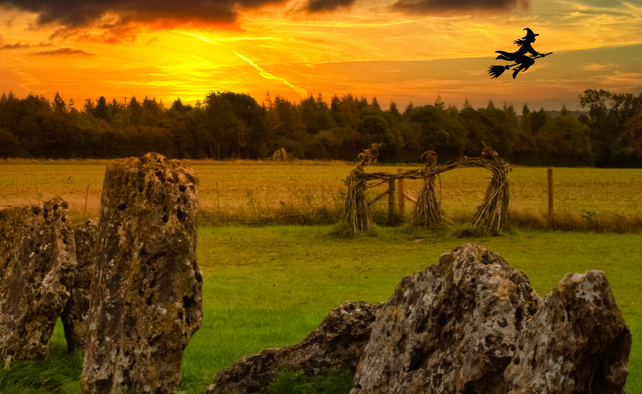
Traditionally seen as hook-nosed green women, covered in warts that cackle through the sky, the story of witches is much darker than one might think. With Henry VIII’s upheaval of the church, it was believed that dark forces had been given the opportunity to creep in; as a result, laws were passed to define these evil doers and how they should be prosecuted, known henceforth as witches.
Between self-proclaimed ‘Witchfinder Generals’ like Matthew Hopkins and parliaments passing death-penalty laws, the women accused of witchcraft often stood little chance, with few ways to prove that they didn’t summon spirits and dance under the moonlight.
Oxford was not immune to the witch craze, with hundreds of stories of strange happenings and accused innocents echoing throughout our history.

Perhaps one of Oxfordshire most famous legends is that of the Rollright Stones. Although they stand in the Cotswolds today, their story begins much further north, in a small cave in North Yorkshire.
On a stormy night, as howling wind tore trees from their roots, a baby was born by a skull-shaped pool in a cave in the Forest of Knaresborough. Legend says she did not cry when born, but instead let out a deafening cackle that silenced the storm. The child would grow up to be Mother Shipton, a legendary prophet and storyteller whose predictions were said to foretell events ranging from the Great Fire of London to the arrival of iron ships.
One day, or so the stories go, a king and his knights were marching across the Cotswolds. The king and his knights stopped at a village inn to warm themselves by the fire. There, the king spotted Mother Shipton.
The King approached the woman with all the bravado and confidence he could muster and demanded that she make him great. With a smile, Mother Shipton made yet another of her legendary prophecies.
“Seven long strides thou shalt take, says she,
And if Long Compton thou canst see,
King of England thou shalt be!”
Encouraged, the King laughed and set off towards a nearby ridge. But before he could complete his seventh stride, the witch began to cackle aloud, the sound splitting the sky like thunder.
“As Long Compton thou canst see, King of England thou shalt not be!
Rise up stick and stand still stone, For King of England thou shalt be none,
Thou and thy men hoar stones shall be, And I myself an elder tree!”
The earth began to shake and shift. As his men ran ahead to protect him, the ground rose, blocking Long Compton from view. Four knights held back, whispering in fear as they watched their brothers-in-arms slowly shift and change. Limbs and armour became stone, flesh and blood became rock as each man froze in place, transformed. The four gathered together, holding close as they too began to change, looking to the sky one last time.
According to legend, these men became the Rollright stones.
The stones are said to dance under the moonlight, and folklore says that no man shall count the stones three times and find the number the same Yet people continue to try as another legend also states that any who do will receive their heart’s desire. One local baker supposedly laid a loaf on each stone as he walked around to keep track of his count; when he tried to collect them, however, the loaves were missing, stolen away by unknown spirits.
Another story tells that a farmer took one of the knight’s stones to make a bridge. It took 24 large horses to drag the stone down the hill, with a man being killed along the way. Despite being laid across the water, every morning the farmer would find the stone flipped upright on the banks. Eventually, the crops failed, and the ground began to sour. In a last-ditch effort to save his livelihood, the farmer returned the knight to where he had found him. The earth recovered, and it took only one horse to return the stone to its place.
Plan your journey to the Rollright Stones
Folklore and tall tales
Oral traditions, legends and tales have been told as long as people have been able to speak, and Oxfordshire is no exception. Though many of the stories you will have read so form part of our area’s cultural tapestry, the proverbs, poems and stories of Oxford extend far beyond what can be recorded here.
From phantasmal livestock to extraterrestrial visitors, here’s some of our favourite Oxford legends.

In 1934, the Great Western Railway opened a small station in the little village of Finstock, known as Finstock Halt. With a local population of less than a thousand, the station is one of the least used in the country, served by only two trains a day, one towards Didcot and one heading back towards Evesham.
Finstock itself is an even quieter place than the station, featuring occasionally in literature and Roman coinage often showing up in the soil. In 1968, however, one strange encounter put the village firmly into local folklore.
Mrs Eileen Claridge was an upstanding member of her community. The Claridge family had lived in the area for centuries, and were known as reputable, sensible people, not the sort prone to flights of fancy and stirring up trouble.
Late one evening, Mrs Claridge was cycling home to Finstock, on a stretch of road above the railway, when something caught her eye. On the tracks stood a giant, four-legged creature. Its long, shaggy coat was as black as midnight, and its cloven hooves clattered along the metal rails of the tracks. Around its neck, a trailing, broken chain rattled, occasionally clanging into the tracks with a great crack.
It was… a goat.
Mrs Claridge followed the nanny-goat on her bicycle some way along the tracks. The last train had long since departed, and she hoped to catch the creature and bring it to safety before the morning train arrived. Though she cycled frantically, she could only watch as the animal leapt onto a nearby path and disappeared before her eyes.
A little further up the road, Eileen Claridge caught up with her partner, frantically asked whether he had seen the goat. To her surprise, he had seen nothing at all, just the light of her bicycle. It wasn’t until much later that another local woman confirmed that she too had seen the ghostly goat, on a similar night under similar circumstances.
The cloven-hooved spectre hasn’t been sighted since, but on a quiet evening at the station, who knows? You may just hear a spooky bleat…
Plan your journey to Finstock Railway Station

On the topic of mysterious animals roaming Oxfordshire, the residents of Otmoor have spent the last 30 years telling stories of an unusual creature.
July of 1994 was a busy time to be alive. Jeff Bezos had just founded a little online bookstore; Brazil won the World Cup with penalties, and Wet Wet Wet spent nine weeks at number one with Love is All Around. For 15-year-old schoolboy Lewis Watson, however, something far stranger was about to happen.
In the family garden at their home in Fewcott, Lewis was kicking about a ball and keeping himself generally entertained when he heard paws on the pavement behind him. Assuming it was the family labrador, he turned to throw the ball for the pup, but he wasn’t met with a dog.
Instead, a large black cat stared back, unblinking.
The animal was said to be the size of a leopard. The beast and Lewis stared at each other for what felt like an eternity before it loped off, over the fence and into fields behind the house.
Another resident, Mrs Pat Warner, snapped a picture of the cat in her elm tree. Though a far-fetched claim, the photo proved enough for local police to investigate. Inspector Jim McBeth was quoted in the local newspaper, saying:
“There is no doubt that we have some wild cat in the area.”
Despite warnings to the public to stay away, sightings continued for years. As recently as 2017, the beast was spotted crossing the road in Upper Arncott. But is it a hoax, or genuine local wildlife?
Plenty of cryptozoologists have tried, and failed, to prove the existence of the UK’s big cats, including the case of one researcher needing to be rescued after getting stuck in his own trap for two nights! No large cat has ever actually been positively identified in relation to one of the “Beast” stories, and many end up being attributed to escaped dogs and public imagination.
With claims of big cats in the UK from Bodmin to the Scottish Highlands, it’s easy to assume that there is something living in the wilds of Britain. Authorities have certainly taken the sightings seriously, even dispatching Royal Marine snipers to South Molton when the original Beast of Exmoor killed over a hundred sheep in the space of three months.
There have been numerous reports of big cats being released from private collections since the introduction of the Dangerous Wild Animals Act in 1976. As recently as 2025, two lynxes were captured in Kingussie, Scotland. The pair were far too tame to have been living wild all their lives, and bedding was found in a nearby layby. After they were transferred to the Highland Wildlife Park, two more were spotted in the area, though they were never caught. Earlier still, a mountain lion was caught in Scotland and rehomed at a wildlife park under similar conditions. She was called Felicity and reportedly enjoyed a fuss.
With all that being said, perhaps there is something after all to the stories of the Beast of Otmoor. So be careful if you decide to explore the area for yourself; if you’re hunting for the beast, the beast may well be hunting you…
Plan your journey to Fewcott

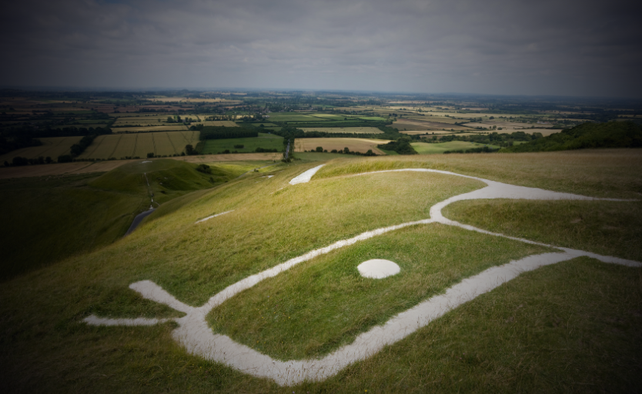
Few landmarks in Oxfordshire, outside the city centre, are as iconic as the Uffington White Horse. A great Celtic carving, the horse stands proudly on the slopes of the appropriately named Whitehorse Hill, a little way south of Faringdon, east of Swindon and the Wiltshire border. Fiercely protected by locals, nobody knows exactly who carved the horse, or why, though theories abound. The prevailing theory is that it was a Celtic religious totem linked to the position of the midwinter sun. Although paganism gave way to Christianity, local affection for the horse remained, as did the legends surrounding it.
Beside the White Horse is a small dip in the hillside known as The Manger. Allegedly, this is where he goes to graze at night, when nobody is watching. Once every hundred or so years, he is also said to trot down from his hill to the nearby Wayland’s Smithy, a legendary landmark in its own right, to be fitted with a shiny new pair of shoes.
Another local belief relates to the horse’s lone eye. It is said that those who stand at the very centre of the large white dot will have any wish they make come true, leading to the horse being something of a pilgrimage for passers-by.
Just below the White Horse’s hillside is a natural hillock that holds many legends of its own. On the flat-topped surface, overlooked by the great horse, it was apparently here that St. George slew the dragon. Where the creature bled after being struck by St George’s lance, no grass grows, leading to a distinct bald patch on the hill.
Another rumour is that the name Dragon Hill comes from Pendragon and is the burial place of the Once-and-Future-King Arthur. When England is in its greatest peril, and the people need him most, King Arthur, it is said, will rise again to defend it. According to a more local legend, the White Horse will rise too, and dance upon Dragon Hill to herald Arthur’s return.
Plan your journey to the Uffington White Horse
The Oxford Ghost Tour
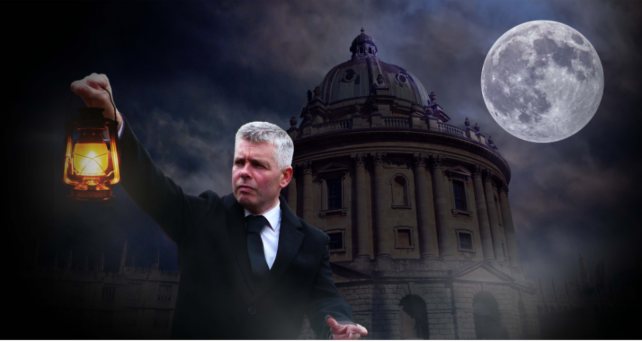
If you’ve been thoroughly spooked, or intrigued, why not join The Oxford Ghost Tour?
Explore Oxford’s haunted history on our 75-minute walking tour, devised by your preternatural host, Tom McDonnell, author of Dead but Awake: Paranormal Encounters from The Shadows of Oxford. Discover terrifying tales of ghostly encounters, unexplained phenomena and Civil War strife, all in the beating heart of Oxford.
Hear fables of spurned love, phantom soothsayers and ghoulish games as you explore cobbled streets and an older, darker side of the Dreaming Spires, departing at 17:00 sharp daily from 24th October to 1st November.
It is worth noting that the tour includes ghost stories and themes which may not be suitable for young children; parental discretion is advised.
Places on the tour are limited, and places are filling up quickly, so book now to avoid disappointment!